

NetSuite Implementation in Malaysia: What Happens Before Go-Live Determines Everything
A NetSuite go-live rarely fails because of the software.
It fails because the business never decided how it would operate, and the system was left to guess.
When planning a NetSuite implementation in Malaysia, most SMEs treat the process purely as a technology decision: which platform, which partner, which timeline.
But a NetSuite implementation in Malaysia is a business redesign project before it is a technology project. What decides whether the system delivers value is settled in the weeks before configuration begins, not the months of build that follow.
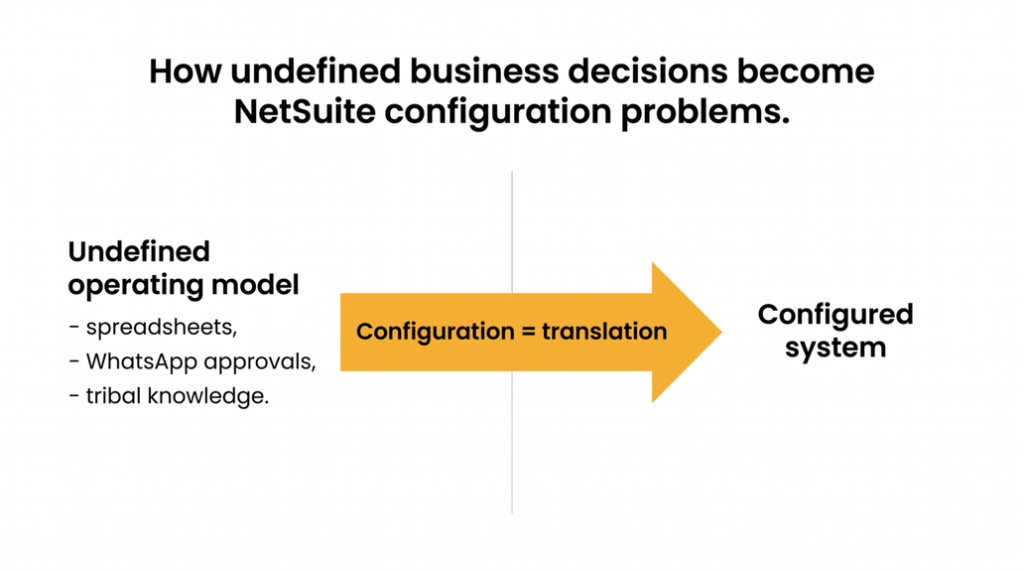
Configuration is translation. It converts decisions the business has already made into system settings. When those decisions have not been made, configuration becomes guessing, and guessing at go-live becomes firefighting after it.
Key Takeaways
- The real project is the business, not the software: go-live succeeds or fails on operating-model decisions made before configuration, not on the platform.
- Undefined ownership becomes a system defect: when nobody owns the customer master, the chart of accounts, or approval authority, the system enforces the confusion instead of fixing it.
- Malaysian factors punish an undefined model: LHDN MyInvois e-invoicing, the expanded SST scope, missing bank feeds, and EPF/SOCSO/EIS/PCB payroll are data-governance decisions, not checkboxes.
- Decision rule: if you cannot name who owns each critical process before configuration starts, you are not ready to configure.
Why a NetSuite Go-Live Fails Before Configuration Begins
A NetSuite go-live fails when the business hands undecided questions to a system that has no patience for ambiguity.
Oracle NetSuite is flexible, but flexibility is worth nothing if the business using it has not decided how it wants to run.
Gartner projects that by 2027, more than 70% of recently implemented ERP initiatives will fail to fully meet their original business goals. That is not a software defect. That is a business that never defined the operating model the software was meant to enforce.
Success is not the ribbon-cutting on go-live day.
In the room after, the most common post-go-live challenges follow one pattern: the system works technically, and operations quietly revert to spreadsheets. Not because the software failed. Because the business was never redesigned to match it. That reversion is usually the same misalignment that was already there before the project started, which is why Malaysian SMEs outgrow their ERP before they know it.
The decisions that matter most in an ERP project are not technology decisions. They are business operating decisions that happen to have a system consequence.
Three Business Decisions NetSuite Will Enforce Permanently
In a NetSuite build, these three choices present as configuration settings: a dropdown, a hierarchy, an approval matrix.
Each one is a business rule the platform enforces on every transaction from that point forward. Define it before configuration starts, and the system translates it accurately. Leave it undefined, and whatever was assumed during a build workshop runs with the same permanence.
Who Owns the Customer Master
Customer master ownership decides whether your e-invoicing runs or breaks.
In Malaysia, MyInvois compliance depends on clean customer master data: valid buyer TIN, buyer registration number (BRN), and accurate SST status must exist before a transaction flows. The submission mechanism can be automated with LHDN e-invoicing built into NetSuite, but the data behind it cannot.
Ask which team creates a customer, who validates the tax fields, and what happens when a status changes.
Decide ownership before configuration, and you build the exact process the system needs. Try to decide it during configuration, and you end up building around existing bad habits: usually email approvals and a shared spreadsheet.
How the Chart of Accounts Is Structured
Chart of accounts structure decides your reporting capability for years, because in NetSuite it does not change after go-live without reclassifying every transaction booked under the old structure.
The number of cost centres, and whether they are department-based or project-based, should follow business requirements, not system convenience. NetSuite gives you financial segments to carry that structure, and how those segments are defined is a business decision before it is a system one.
Settle this in a rushed build workshop, and you end up with a compromise that constrains reporting until someone pays to unpick it.
Who Can Approve What
Approval authority is an operating decision the system enforces to the letter.
Can a manager approve their own department’s spend? Can finance override operations on a requisition? What happens when the approver is on leave?
Configure that logic without testing it against real scenarios, and you get a workflow so rigid teams bypass it, or so loose it controls nothing. Approvals then happen on WhatsApp and get keyed in later. Committed spending can no longer be trusted.
That is not poor adoption. That is an undefined operating model, digitised.
Four Malaysian Local Factors Affecting NetSuite ERP Implementations
Every ERP project faces planning pressure. Malaysian projects face four local factors that turn an undefined operating model into post-go-live chaos.
Each one is a demand on data governance or workflow that cannot be retrofitted.
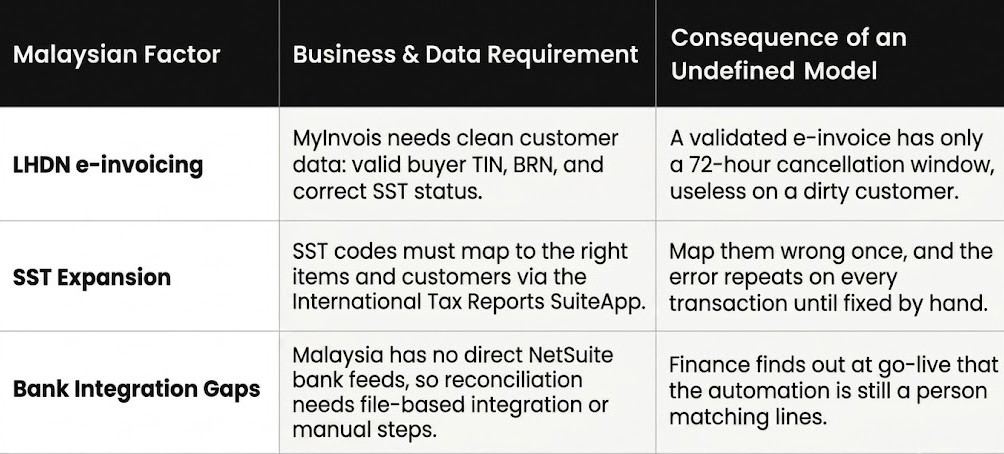
1. LHDN e-invoicing is a data-governance mandate, not a feature.
LHDN’s MyInvois e-invoicing mandate reached businesses with turnover between RM1 million and RM5 million on 1 January 2026. A validated e-invoice can only be cancelled within a 72-hour window before corrections must run through credit and debit notes, and none of it works on a dirty customer master. Ultimately, your MyInvois setup in NetSuite is only as reliable as the data-ownership decisions you made before go-live. A native submission integration such as BOC e-Invoice for NetSuite removes the manual portal work, but it does not decide who owns the customer record.
2. SST is a structural demand on your item and customer master.
The government expanded the SST scope from 1 July 2025, and 2026 is the first full enforcement year. NetSuite handles SST through its International Tax Reports SuiteApp, but the codes must be mapped to the right items and customers. Map them wrong and the error repeats on every transaction until someone reconciles it by hand. This is not a configuration problem. It is a data-ownership problem that shows up in every transaction after go-live.
3. Bank integration gaps extend a timeline you did not budget for.
Malaysia has no direct NetSuite bank feeds for most banks, so reconciliation still needs file-based integration or manual steps. If the finance team has not defined that workflow beforehand, they will discover at go-live that the expected automation is still a person matching lines. That person was not in the project budget.
4. Malaysian payroll is a separate workstream, not a module.
NetSuite does not ship built-in EPF, SOCSO, EIS, and PCB tables. Statutory payroll runs through a local provider or integration. If that is not scoped before the project starts, payroll goes live and stays broken until someone funds the custom work.
None of these are technology surprises. They are business decisions the timeline pretended it could skip.
Ready to Stop Guessing and Start Configuring?
What the Four Weeks Before Configuration Actually Decide
The weeks before configuration decide the operating model, and this is the phase most NetSuite go-live preparation in Malaysia rushes through.
It is also where BlackOak does its most important work: the process-definition work that has to happen before a single field is set.
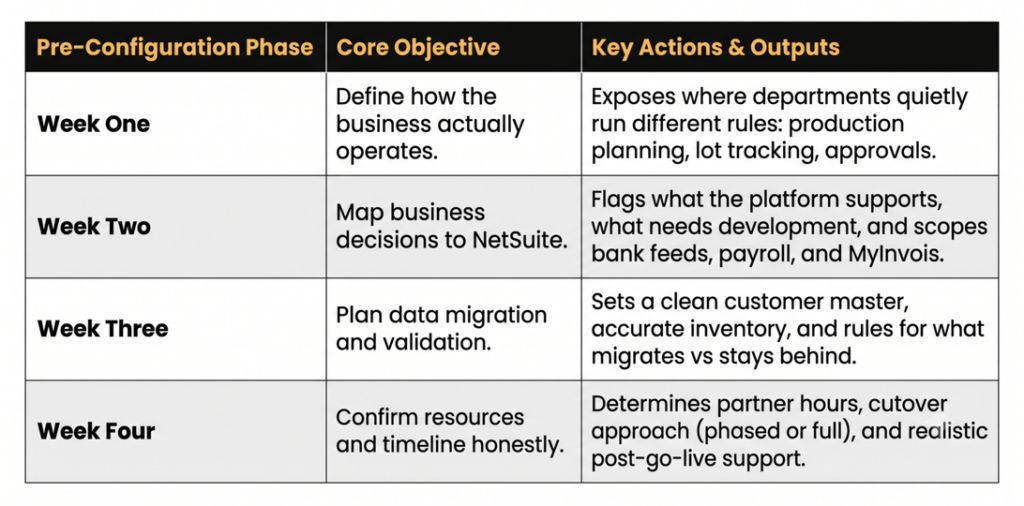
1. Week one: Define how the business actually operates
Not in theory, in practice.
For a discrete manufacturer: whether production planning is centralised, how lot tracking works, who approves a schedule change.
For High-Volume, Low-Value (HVLV) retail operations: how returns trigger cost reallocation, whether pricing is regional. These conversations expose where departments quietly run different rules.
2. Week two: Map those decisions to NetSuite
Where the platform supports the process. Where you need development. Where the business bends instead.
This is where the bank-feed gap, the payroll workstream, and MyInvois stop being surprises and become scoped work.
3. Week three: Plan data migration and validation
A clean customer master, accurate inventory balances, and clear rules for what migrates and what stays behind.
Data quality decides whether the first 90 days are stable or a reconciliation project.
4. Week four: Confirm resources and timeline honestly
That is a sound NetSuite implementation process: define, map, migrate, resource, then build. Skip it, and your ERP project will produce messy workarounds instead of streamlined processes.
How Pre-Configuration Planning Impacts Your Timeline and Budget
Pre-configuration planning decides your timeline and budget more than any feature does, because the cost of skipping it never appears as a line item.
An unowned customer master leaks out as MyInvois rejections cleared by hand. A compromised chart of accounts leaks out as a month-end close that never gets faster.
Undefined approvals leak out as margin lost, deal by deal, on exceptions nobody priced. That labour never shows on the go-live report. It shows in cycle time, in overtime, and in the headcount that was meant to shrink and did not.
Projects that do this work add a few weeks upfront and go live close to schedule. Projects that skip it save those weeks, then spend months firefighting at their own expense.
The upfront investment is cheaper than the crisis, every time.
Why BlackOak Consulting

BlackOak Consulting exists to close the gap between how a business says it operates and how it actually does, before that gap becomes a configuration problem.
We are the people who have seen what breaks after go-live and know how to prevent it beforehand.
- Founded in 2020, our leadership team brings over 17 years of hands-on ERP consulting experience to every project.
- 100+ projects delivered across 16 industries, backed by 50+ combined years of team expertise.
- A certified Oracle NetSuite partner, focused solely on Oracle NetSuite from implementation to support, and to licence. This is why working with a NetSuite solution partner matters from the first workshop onward.
- HVLV retail and discrete manufacturing specialists, fluent in BOM revision control, landed cost, three-way match, and cost-to-serve.
- A pre-implementation methodology that defines the operating model first and configures second.
- Post-go-live support built for the first 90 days, when most ERP projects actually succeed or fail.
Conclusion
The moment you sign the Oracle NetSuite contract, a clock starts.
It is not a clock for configuration. It is a clock for business alignment.
Companies that treat that phase as optional spend months building a system that does not match how they operate. Companies that treat it as non-negotiable define the operating model first, map it to NetSuite honestly, and plan for the Malaysian factors explicitly.
A NetSuite implementation is only as useful as the decisions made before anyone starts configuring. Design the business first. Configure the system second.
Want to see how this pre-configuration approach solves local challenges? Read our complete guide to Oracle NetSuite Implementation in Malaysia.
Ready to Stop Guessing and Start Configuring?
FAQ
Readiness for an ERP has little to do with company size and everything to do with operational clarity. Your business is ready if you can answer these questions: Who owns each major process? What are the decision criteria at each approval point? Where does your data live, and how is it reconciled across systems? What reports do you actually use, and who uses them?
If you need to sit with the same person for three days to answer those questions because they are the only person who knows the answers, you are not ready for an ERP. First, you need to make that knowledge explicit, documented, and executable without relying on one person's experience.
Accounting software (QuickBooks, Xero, Tally) is built for financial transactions. It handles invoicing, payments, and P&L reporting well. Manufacturing or retail ERP systems integrate inventory, production, purchasing, and financial flows together. You outgrow accounting software when the decisions you need to make require visibility across purchasing, operations, and finance simultaneously. You need an ERP when those decisions are happening in real time and you cannot afford to wait for month-end reporting to know the answer.
Yes. NetSuite is a SaaS platform, which means the infrastructure is hosted and managed by Oracle. Your business does not need to maintain servers or IT infrastructure. What you do need is operational clarity, data readiness, and a project structure that answers hard questions about how the business will actually work in the system. Many Malaysian SMEs implement NetSuite successfully with a combination of internal business stakeholders, a certified implementation partner, and minimal IT involvement beyond basic access management.
Results have two different timelines. Operational results (the ability to see what is happening in your business and respond faster) often appear within 1–2 months after go-live if the implementation team has configured the system to reflect the actual process. Financial results (measurable improvements in margin, working capital, or operational efficiency) usually take 6–12 months because they depend on the business actually using the system for decision-making, not just transaction processing.
Your data either enters the ERP correctly or it enters incorrectly and creates problems downstream for the next two years. Data migration is not a technical task to be handled by the IT team in the week before go-live. It is a business task that should begin during the planning phase, long before implementation starts. The migration requires: identifying which data is accurate and which is outdated; reconciling conflicting data across systems; standardizing codes and formats; and validating results after the move. Most project delays and post-implementation problems trace back to data issues that could have been resolved before go-live if they had been treated as a business priority rather than a technical handoff.

About the Author
Kuan Boon Lim
Meet Kuan Boon Lim, the Netsuite Proselytizer wanabee! who is dedicated to spreading the good word about seamless business management and NetSuite to all who will listen. With years of experience in ERP pre-sales, implementation, he is fully equipped to help businesses of all sizes take their operations to the next level.
He is currently the GM of Pre-sales for BlackOak Consulting Sdn Bhd.
