
Which E-Invoice Implementation Date Applies in 2027
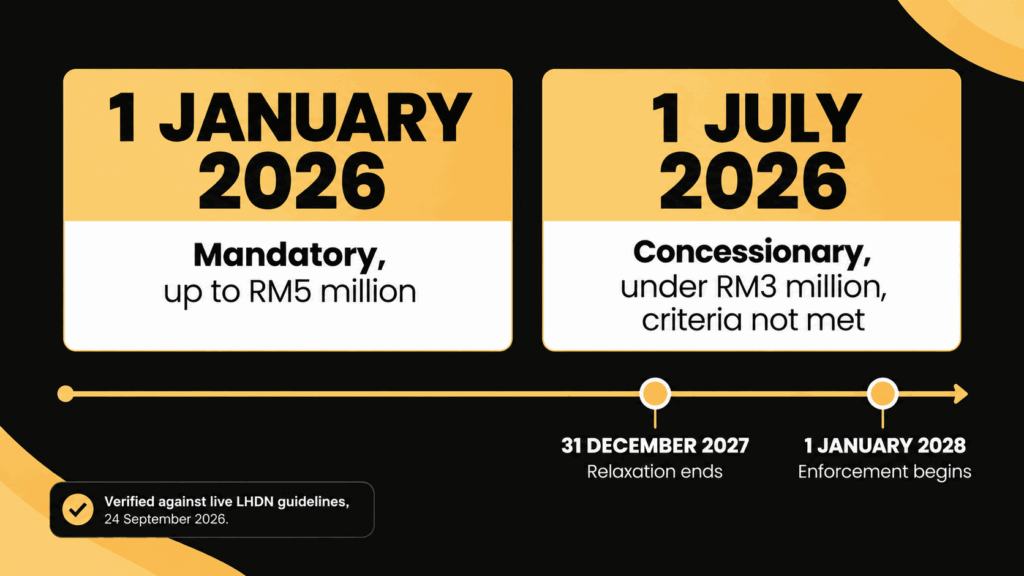
Malaysia’s final e-Invoice implementation date was set for 1 January 2026. However, if your business generates under RM5 million in revenue, your e-invoice start date depends on historical turnover, the years revenue was earned, and your business ownership structure.
Your deadline will fall on 1 January 2026, 1 July 2026, a subsequent 1 January, or you may be entirely exempt.
Key Takeaways
- Mandatory implementation for businesses earning up to RM5 million remains 1 January 2026.
- Companies earning under RM3 million are exempt only if they lack an ownership link, such as a corporate shareholder, holding company, or related joint venture generating RM3 million or more.
- Failing the ownership test triggers a concessionary deadline of 1 July 2026.
- Exempt businesses that later reach RM3 million permanently lose their exemption. The deadline becomes 1 July 2026 (if crossed between YA2023–YA2025) or 1 January of the second year following the assessment year (if crossed from YA2026 onwards).
- The interim relaxation period ends 31 December 2027, which only simplifies how to issue e-Invoices, not whether to issue them.
- A subsequent drop in turnover does not change an established LHDN e-Invoice implementation date.
- Missed or inaccurate e-Invoices can be corrected via the e-Invoice SVDP until 31 December 2027. Exempt businesses are excluded.
- If your FY2022 turnover exceeded RM5 million, your deadline occurred in an earlier e-Invoice Phase 4 rollout, and the relaxation period has expired.
What Is the E-Invoice Implementation Date in Malaysia?
The e-invoice implementation date Malaysia enforces is tiered by annual turnover. LHDN phased this rollout from 1 August 2024 to 1 January 2026, while offering a concessionary date of 1 July 2026 for specific businesses under RM3 million.
Conflicting dates exist online because LHDN revised its guidelines repeatedly during 2026, most recently on 7 September.
Articles citing superseded versions remain live online, preserving outdated figures like the old RM1 million exemption threshold (which was updated to less than RM3 million on 30 August 2026 under Guideline v4.8).
Current versions can be verified on the LHDN guidelines index, which on 24 September 2026 lists e-Invoice Guideline version 4.8 (published 30 August 2026) and e-Invoice Specific Guideline version 4.9 (published 7 September 2026).
This e-invoice implementation timeline separates enforcement deadlines from interim relaxation periods:
Annual turnover or revenue | Implementation date | Interim relaxation period |
More than RM100 million | 1 August 2024 | Ended 31 January 2025 |
More than RM25 million, up to RM100 million | 1 January 2025 | Ended 30 June 2025 |
More than RM5 million, up to RM25 million | 1 July 2025 | Ended 31 December 2025 |
RM3 million to RM5 million | 1 January 2026 | Until 31 December 2027 |
Less than RM3 million, ownership link applies | 1 July 2026 (concessionary) | Until 31 December 2027 |
Less than RM3 million, no ownership link | Exempt | Not applicable |
Standard rules take effect 1 January 2028 when all temporary concessions end. LHDN defines the final tier as “annual turnover or revenue of up to RM5 million” with no minimum floor. Businesses under RM3 million that fail the ownership test still face a 1 July 2026 deadline.
Know Your Date. Now Check Your System.
How to Determine Your Exact Deadline in Four Steps
Answer four questions to determine your exact deadline:
Question 1. Which turnover figure, from which source?
LHDN determines your band from financial year 2022, using the bases in Section 1.5 of the e-Invoice Guideline v4.8.
With audited accounts, the figure is turnover or revenue in the FY2022 statement of comprehensive income. Without them, it is the annual revenue reported in the tax return for the year of assessment 2022. If the accounting year-end changed during FY2022, the figure is pro-rated to twelve months.
Sole proprietors add together every business owned or registered in their name when testing against RM3 million (General FAQs Q102).
Important Note: Once the implementation timeline has been determined, later changes in turnover do not change it. The obligation does not lapse even if revenue drops in subsequent years.
Question 2. Which band does that figure fall into?
Above RM5 million routes out of this final timeline. RM3 million to RM5 million lands on 1 January 2026, with no exemption available. Less than RM3 million proceeds to Question 3.
Question 3. Do you meet all three exemption conditions?
A business with a turnover of less than RM3 million loses the exemption if any of the three conditions is present:
- A non-individual shareholder with annual turnover or revenue of at least RM3 million
- Status as a subsidiary of a holding company with annual turnover or revenue of at least RM3 million
- A related company or joint venture with annual turnover or revenue of at least RM3 million
Relatedness runs through companies, not individuals.
A company holding at least 20% of another’s issued share capital makes the two related, and so does a company that controls another’s operations with a smaller stake. A common individual shareholder, or a common director with no shares, does not create relatedness.
Question 4. When did the business commence operations?
If your business cannot use the exemption (either due to an ownership link or because turnover reached RM3 million in YA2023, YA2024, or YA2025), 1 July 2026 is LHDN’s concessionary implementation date.
- Trading in 2022 or earlier:
With FY2022 turnover under RM3 million and an ownership link, the date is 1 July 2026. With no link, the business is exempt until turnover reaches RM3 million.
Reaching it in YA2023, YA2024 or YA2025 brings a 1 July 2026 date, and reaching it from YA2026 brings 1 January of the second year after that year of assessment.
- Started between 2023 and 2025:
Reaching RM3 million in YA2023, YA2024 or YA2025 brings a 1 July 2026 date. Staying under RM3 million in all three years means 1 July 2026 with an ownership link, or exemption without one until turnover reaches RM3 million in a later year.
- Starts from 2026:
With an ownership link, the date is 1 July 2026 or the day operations began, whichever is later. Without one, the business is exempt until the year of assessment in which turnover reaches RM3 million, including its first, and it is implemented from 1 January of the second year after it.
Case Study: RC Cycling Sdn Bhd recorded annual revenue of RM400,000 as of 31 December 2022 and is a subsidiary of JT Motors Sdn Bhd, which has already implemented e-Invoice. Because of the parent company, the exemption does not apply, and RC Cycling implements from 1 July 2026.
Not sure whether your current system can carry the compliance load you are about to place on it? Our piece on why Malaysian SMEs outgrow their ERP covers the structural warnings that surface first.
Limitations of the Relaxation Period
The relaxation period for the up-to-RM5 million band eases how you submit e-Invoices until 31 December 2027, but does not excuse you from issuing them.
Mandated businesses must still submit consolidated e-Invoices monthly to avoid prosecution under Section 120. Exempt businesses have no obligation to issue anything.
Since 1 January 2026, individual transactions exceeding RM10,000 cannot be consolidated and must be processed individually across all industries.
Failure to issue an e-Invoice is an offence under section 120(1)(d) of the Income Tax Act 1967. The penalty is a fine of not less than RM200 and not more than RM20,000, or imprisonment of up to six months, or both, for each non-compliance.
If You Have Already Missed Your Date, the SVDP Window Is Open
The e-Invoice Special Voluntary Disclosure Programme (SVDP) allows non-exempt businesses to correct past mistakes from 7 July 2026 to 31 December 2027 without formal registration.
Exempt businesses do not need to use the SVDP. A company under RM3 million with no ownership link can stop issuing mistakenly generated e-Invoices immediately.
- Submit disclosures using e-Invoice version SVDP 1.2 (no digital signature) or SVDP 1.3 (with digital signature).
- Reverse incorrect e-Invoices with a credit note and issue a new, accurate e-Invoice.
- Submit missed consolidated e-Invoices based on the month transactions occurred, rather than as a single lump sum.
- Each corporate group entity must file its own independent disclosure.
The programme does not cover fraud, wilful default or negligence.
The SVDP window and the relaxation period both close on 31 December 2027. From 1 January 2028, businesses in this band work under normal rules with no programme behind them.
From Compliance Date to System Readiness
Knowing your deadline is only the first step. Ensuring your system can handle the compliance load is the next. Whether you are using a local accounting package or a mid-market suite like Oracle NetSuite, meeting your deadline depends on three things inside the system:
- Master data carrying the fields LHDN validates, including buyer TINs.
- Transaction volume, which decides whether the MyInvois Portal stays practical or API integration becomes the better fit.
- Transactions exceeding RM10,000, which must be identified one by one rather than left for the month-end consolidation.
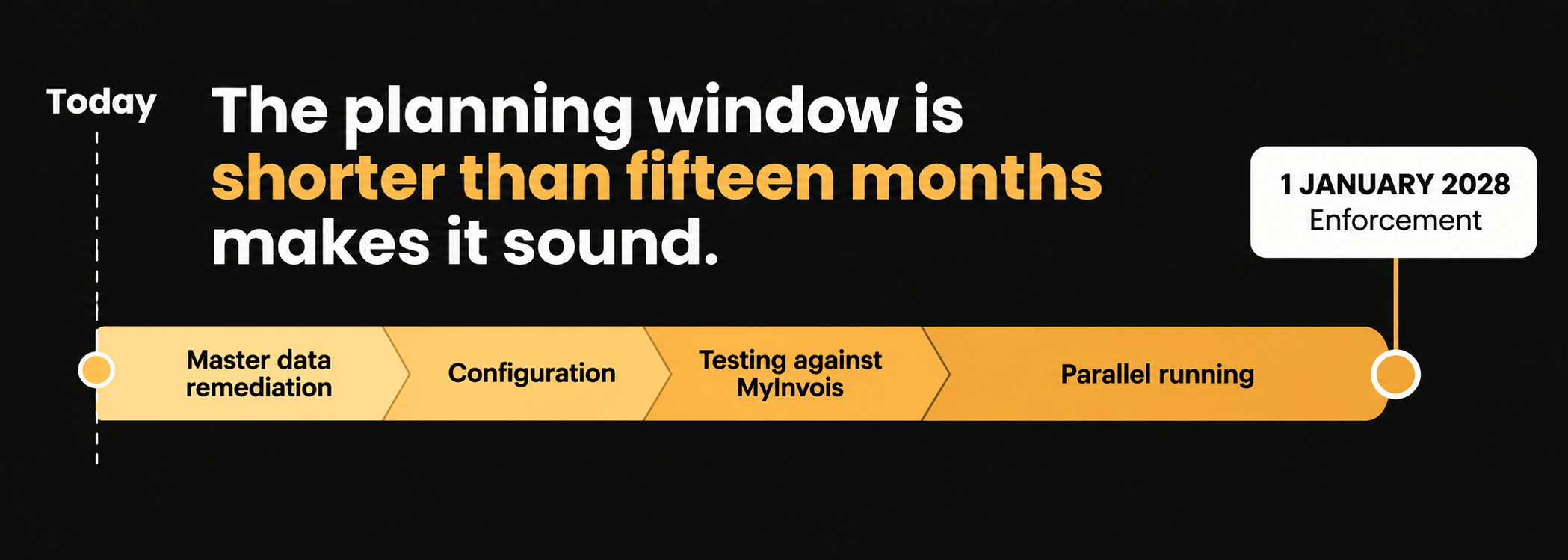
Work backwards from 31 December 2027 rather than forwards from today. Once data remediation, configuration, testing against MyInvois and parallel running are counted, the planning window is shorter than it looks.
Wondering what actually determines whether a compliance deadline gets met on time? Our piece on NetSuite implementation in Malaysia covers what has to be settled before configuration begins, and our ERP insights and digital transformation hub collects all our coverage in one place.
Conclusion
Settle your date before you settle your system. Four questions give it: the turnover figure that counts, the band it falls into, whether an ownership link removes the exemption, and what the business has earned since it started.
1 January 2026 was the band’s standard date. Yours is the one your turnover and ownership specifically give you.
Why BlackOak Consulting
- Certified Oracle NetSuite Solution Partner in Malaysia, with over 17 years of ERP consulting experience.
- BOC e-Invoice is built natively on SuiteCloud and submits directly to LHDN’s MyInvois API from inside Oracle NetSuite, with no middleware layer.
- Scoping objectively presents both Oracle’s Malaysia Electronic Invoicing SuiteApp and BOC e-Invoice, driven by transaction volume.
- Every date published is re-verified against live LHDN sources on each guideline revision.
For anyone weighing an ERP system Malaysia decision against a compliance deadline, the sequence matters more than the software. The enforcement date has moved. The obligation behind it has not moved at all.
Know Your Date. Now Check Your System.
Frequently Asked Questions
The e-Invoice implementation date in Malaysia depends on annual turnover or revenue: 1 August 2024 above RM100 million, 1 January 2025 above RM25 million up to RM100 million, 1 July 2025 above RM5 million up to RM25 million, and 1 January 2026 up to RM5 million. Businesses under RM3 million are exempt unless an ownership link applies or turnover later reaches RM3 million. With an ownership link, the concessionary date is 1 July 2026.
(Source: e-Invoice Guideline v4.8, Section 1.5, Table 1.1 and Section 1.6.10; e-Invoice General FAQs Q11, Q12, Q13)
FY2022 turnover sets the band, taken from the audited statement of comprehensive income or, without audited accounts, the YA2022 tax return. For a business exempt on that figure, later years also count. Reaching RM3 million in YA2023 to YA2025 brings a 1 July 2026 date, and reaching it from YA2026 brings 1 January of the second year after.
(Source: e-Invoice Guideline v4.8, Section 1.5; e-Invoice General FAQs Q10, Q12)
1 July 2026. It applies to businesses whose YA2022 turnover was under RM3 million, and to businesses that started between 2023 and 2025. Those with no ownership link and turnover still under RM3 million are exempt instead.
(Source: e-Invoice General FAQs Q12, Q13)
For a business starting from 2026 with an ownership link, it is 1 July 2026 or the date operations began, whichever is later. Without one, the business is exempt until a year of assessment in which turnover reaches RM3 million, including its first year, and implements from 1 January of the second year after that.
(Source: e-Invoice General FAQs Q14)
Yes. A subsidiary of a holding company with annual turnover or revenue of at least RM3 million cannot use the exemption, whatever its own turnover. LHDN's example is RC Cycling Sdn Bhd, a subsidiary with RM400,000 in annual revenue that implements from 1 July 2026.
(Source: e-Invoice Guideline v4.8, Section 1.6.10; e-Invoice General FAQs Q99)
Not on that basis. A common director with no shares does not make companies related, and neither does a common individual shareholder. Relatedness comes from a company holding at least 20% of another's issued share capital, or controlling its operations with a smaller stake.
(Source: e-Invoice General FAQs Q103)
Yes, if turnover is under RM3 million and no ownership link applies. LHDN says such a business may stop immediately and needs no approval. It also does not need the SVDP for e-Invoices it missed.
(Source: e-Invoice General FAQs Q15 to Q20)
No. Once your implementation date is set, later changes in turnover do not change the obligation to keep issuing e-Invoices.
(Source: e-Invoice Guideline v4.8, Section 1.5)
(Source: e-Invoice General FAQs Q103)
For businesses with turnover of up to RM5 million, on both the 1 January 2026 and 1 July 2026 implementation dates, the interim relaxation period runs until 31 December 2027.
(Source: e-Invoice General FAQs Q113; e-Invoice Specific Guideline v4.9, Section 16, Table 16.1)
No, unless your business is exempt. The relaxation eases how you issue e-Invoices, but consolidated e-Invoices still go in every month. LHDN's undertaking not to prosecute covers businesses that meet the relaxation conditions.
(Source: e-Invoice General FAQs Q116; e-Invoice Specific Guideline v4.9, Section 16)
Failure to issue an e-Invoice is an offence under section 120(1)(d) of the Income Tax Act 1967. It carries a fine of not less than RM200 and not more than RM20,000, or imprisonment of up to six months, or both, for each non-compliance.
(Source: e-Invoice General FAQs Q41)
Check the exemption first, because a business under RM3 million with no ownership link does not need to act. If you are not exempt, the e-Invoice SVDP runs from 7 July 2026 to 31 December 2027 and needs no registration. Missing consolidated e-Invoices go in month by month rather than as one lump sum.
(Source: e-Invoice General FAQs Q19, Q123, Q127; e-Invoice Specific Guideline v4.9, Section 17)
As at 28 September 2026, the current versions are e-Invoice Guideline v4.8, published 30 August 2026, and e-Invoice Specific Guideline v4.9, published 7 September 2026. The General FAQs were last updated on 4 September 2026.
(Source: LHDN e-Invoice guidelines index, checked 28 September 2026)

About the Author
Kuan Boon Lim
Meet Kuan Boon Lim, the Netsuite Proselytizer wanabee! who is dedicated to spreading the good word about seamless business management and NetSuite to all who will listen. With years of experience in ERP pre-sales, implementation, he is fully equipped to help businesses of all sizes take their operations to the next level.
He is currently the GM of Pre-sales for BlackOak Consulting Sdn Bhd.
