

How to Choose ERP Software in Malaysia: Fit First, Price Second
It’s the fifth working day of the month. Finance is still waiting on the warehouse spreadsheet. The warehouse is waiting on a freight invoice. Someone is asking in the WhatsApp group which entity the import belongs to.
Nobody here has a software problem. They have a system that records what happened instead of running what is happening.
Most lists of ERP software in Malaysia crown a winner. This one won’t, because for a lot of businesses the winner is the wrong choice. We implement Oracle NetSuite, and we’ll tell you where it doesn’t fit.
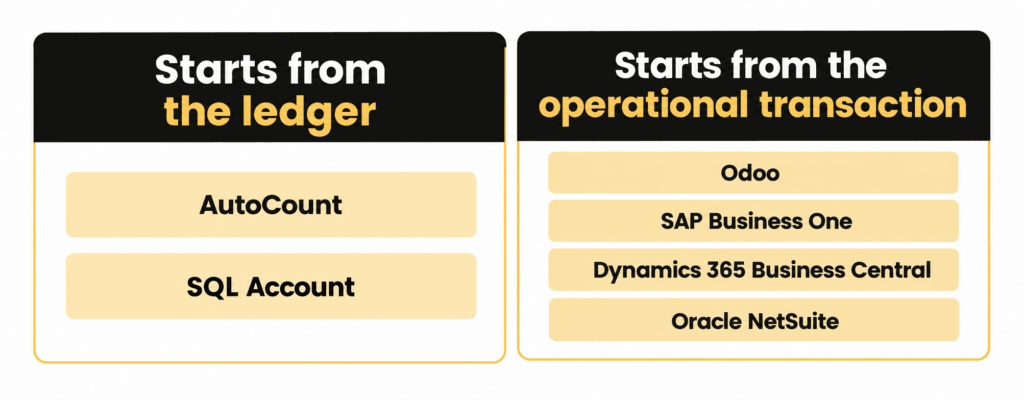
Class First, Brand Second: The Two Types of ERP Software in Malaysia
There are two classes of system, and the first decision is which one your operation needs.
Accounting-led systems such as AutoCount and SQL Account start from the ledger. They suit standard stock-to-invoice trading well, and they go beyond bookkeeping into stock, payroll and e-Invoicing.
Mid-market suites start from the operational transaction, such as a work order or a stock transfer, and the accounts follow from it.
SAP Business One, Microsoft Dynamics 365 Business Central, Oracle NetSuite and Odoo all sit here. They all let you add modules as you grow, so that isn’t what separates them.
What separates them is how they’re built and delivered: who hosts them, who upgrades them, and how much of your fit depends on custom work.
Comparing module counts won’t settle this. How your operation is built will.
Five Triggers That Decide Whether You Need ERP Software
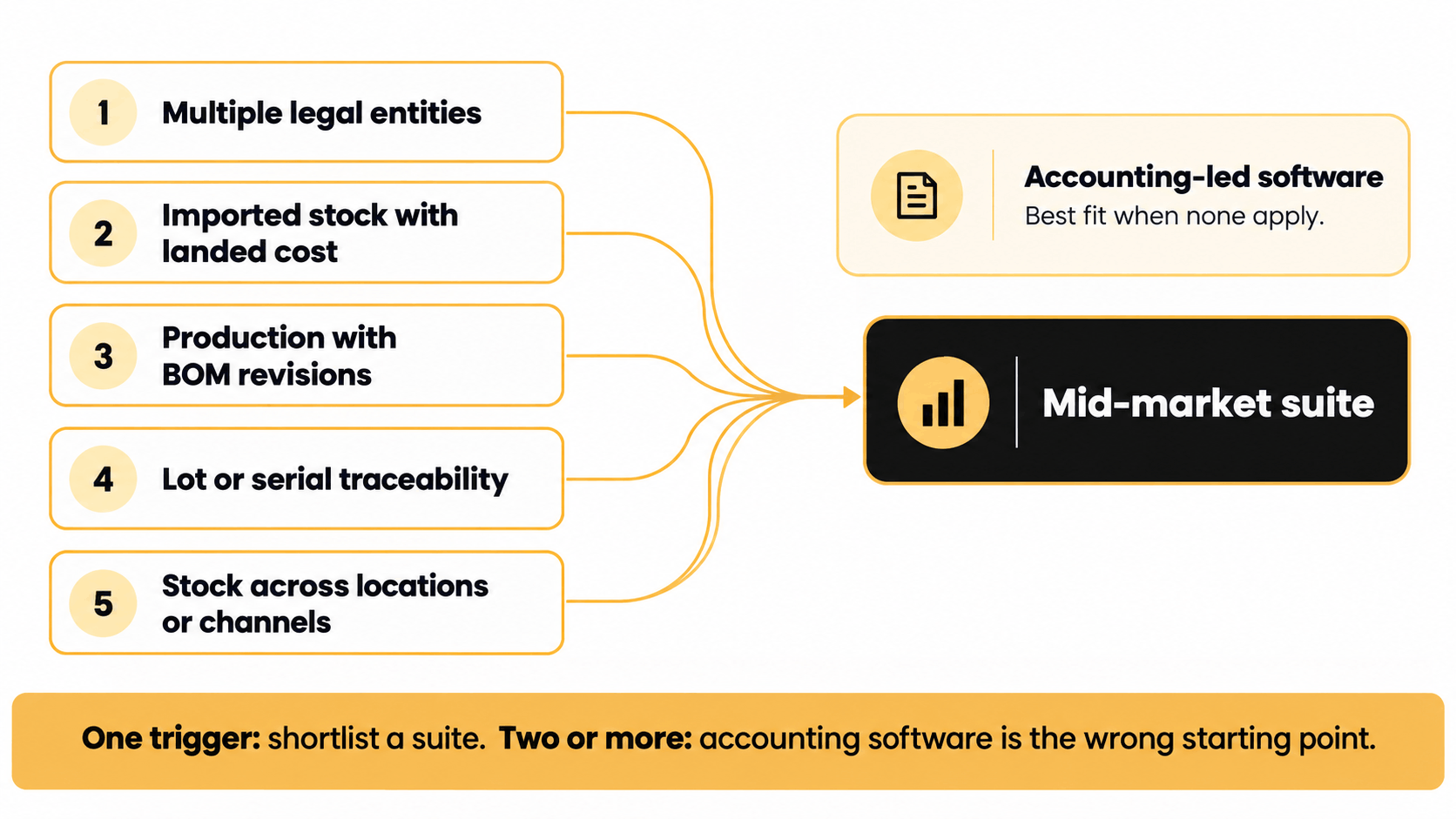
- Multiple legal entities: separate companies consolidated by hand in Excel.
- Imported stock with landed cost: freight, duty and insurance added to item cost after arrival.
- Production with BOM revisions: work orders built against a BOM that engineering keeps changing.
- Lot or serial traceability: a complaint has to be traced to a specific batch.
- Stock across locations or channels: showroom, warehouse and online store drawing on one inventory.
One trigger means a suite belongs on your shortlist. Two or more and accounting software is probably the wrong place to start. None means accounting-led software is likely enough. A RM40 million trader with one entity and a standard flow shouldn’t buy a suite.
One reconciliation spreadsheet is an exception. One in every department is your operating model, and it’s telling you the system has run out of road.
Decide How the Business Runs Before You See a Demo
Gartner predicts that by 2027, more than 70% of recently implemented ERP initiatives will fail to fully meet their original business goals. A lot of that starts when software is shortlisted before anyone has decided how the operation should work.
For most ERP for SME Malaysia decisions, the homework below narrows the shortlist faster than any demo will. Before the first demo, write down:
- One order traced from quote to cash
- Decisions currently living in spreadsheets or WhatsApp groups
- Who owns each exception
- Your entities, locations and channels today, and in three years
If nobody can say who owns an exception today, no system will decide it for them.
Six ERP Platforms in Malaysia, Grouped by Class
Platform | Class | Choose it when | Look elsewhere when |
AutoCount | Accounting-led | Finance leads, trading is standard, local accountant familiarity matters | Several triggers apply, especially multi-entity |
SQL Account | Accounting-led | Accounting, stock and SST in one local package fits | Same as AutoCount |
Odoo | Suite, open-source core | You want flexibility in hosting and customisation, and you trust a strong partner to own the code | You want a vendor-run platform where upgrades don’t depend on a partner’s custom work, or the partner’s depth on your process is unproven |
SAP Business One | Mid-market suite | You want the SAP ecosystem through a partner-hosted deployment | You prefer a vendor-updated multi-tenant cloud |
Dynamics 365 Business Central | Mid-market suite | You already run on Microsoft 365, Teams and Power BI | Microsoft integration isn’t a deciding factor |
Oracle NetSuite | Mid-market suite | Multiple entities, locations or channels need one cloud platform with consolidated reporting | Any condition in the next section applies |
Most roundups of the top ERP systems Malaysian SMEs see are ordered by popularity. The table above is grouped, not ranked. ECOUNT, Epicor, Acumatica and Infor are also shortlisted by some businesses.
Notice that none of these rows says “can’t handle multiple entities” or “can’t handle production.” Several platforms can, in principle. Whether one does it well for your business depends on the edition, the configuration and the partner, which is why the demo test below matters more than any table.
Myth: NetSuite is only for large enterprises.
Reality: The trigger is operating complexity, not headcount or a foreign office. We scope NetSuite projects by entity, location and channel structure.
Find Your Class Before the Demos
When Is Oracle NetSuite the Wrong Choice?
- One entity, standard stock-to-invoice flow. The extra cost and complexity aren’t justified.
- Nobody will own it. Without an executive sponsor and a named system owner, your implementation partner ends up making business decisions by default.
- The brief is “work like the old system.” Customisations that preserve legacy habits carry into every upgrade.
- Regulated process manufacturing. Standard production records are built around assemblies and BOMs. Recipe and batch control need Oracle’s Advanced Manufacturing module or partner SuiteApps. Plan for that early, or compare against a process ERP.
- Outlet-heavy retail that needs native POS. NetSuite has no native POS, so a retail chain needs a POS integration. Scope and budget for it before you commit.
Not sure whether your operation fits? Talk to our pre-sales team and we’ll tell you honestly.
Does e-Invoicing Force You to Buy an ERP?
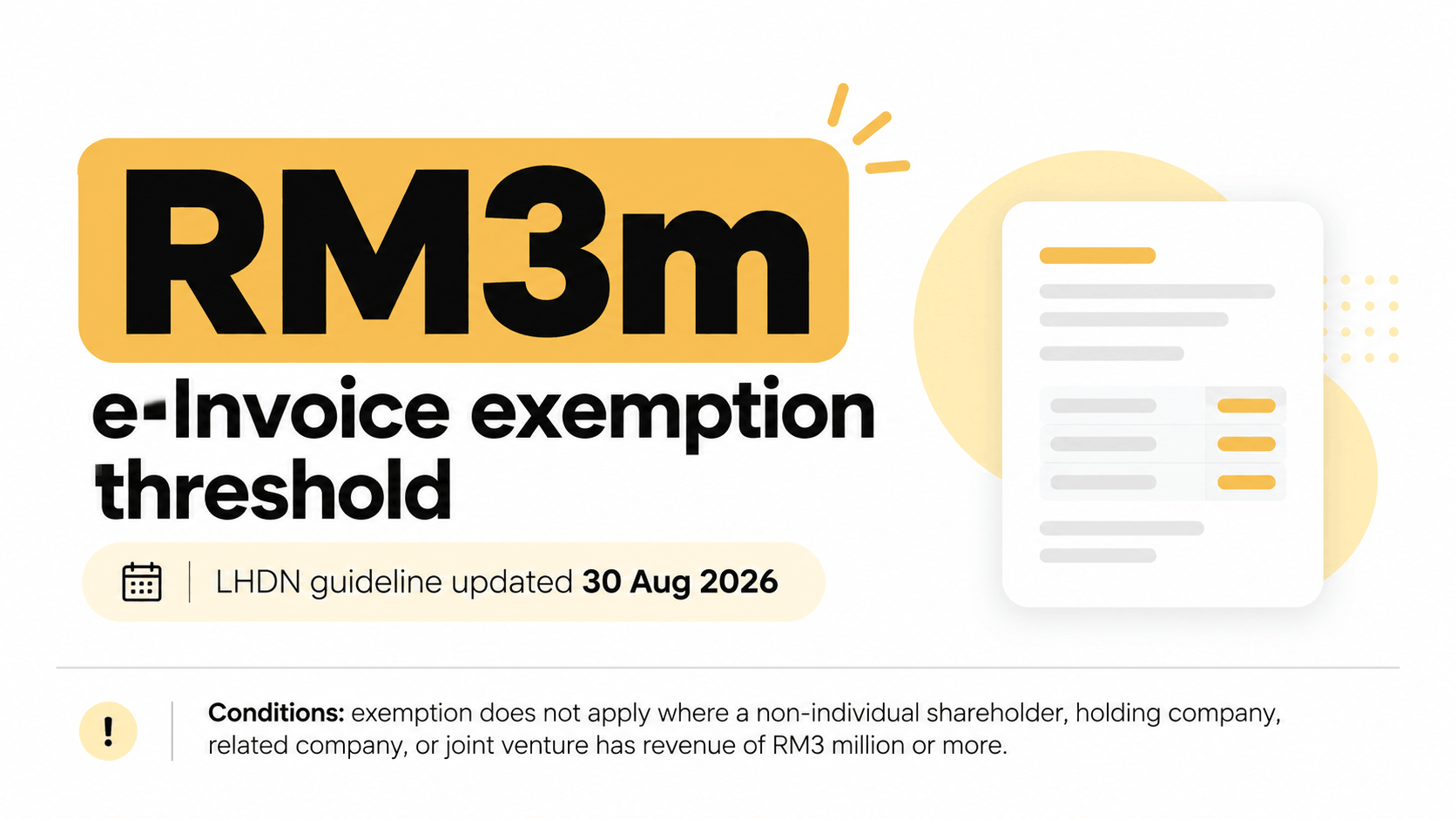
No. Eligible taxpayers with annual turnover or revenue below RM3 million are exempt from e-Invoice implementation, under LHDN’s guideline updated on 30 August 2026.
The exemption doesn’t apply where a non-individual shareholder, holding company, related company or joint venture has revenue of RM3 million or more.
Myth: e-Invoicing means we must buy an ERP now.
Reality: In-scope businesses can submit through LHDN’s free MyInvois Portal, and AutoCount and SQL Account submit e-Invoices too. An ERP becomes practical when invoice volumes are high, or when self-billed and individual e-Invoices are too much to manage manually.
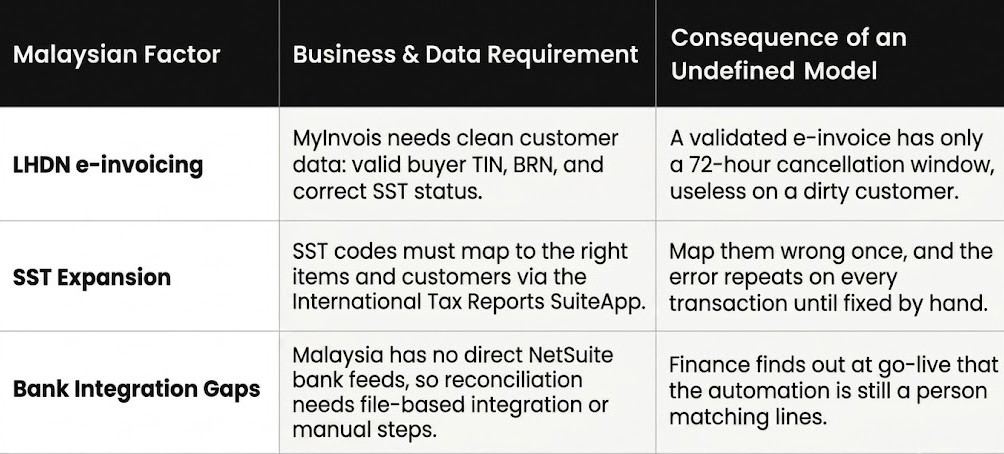
On NetSuite, Oracle’s Malaysia Electronic Invoicing SuiteApp generates the documents and sends them to IRBM through Avalara access points. It requires a NetSuite Electronic Business Network Extension licence with Avalara processing volume.
Our own BOC e-Invoice runs on SuiteCloud inside NetSuite and submits directly to the MyInvois API, in real time or in batches. Which route suits you depends on your transaction volume and on who will manage the integration after go-live. We cover both during scoping.
Test ERP Fit With Your Own Transactions
A free trial tests the interface. A scripted demo tests fit. Ask every vendor on your shortlist, Odoo and NetSuite included, to run these live on your items, customers and exceptions:
- An import receipt with freight and duty applied as landed cost
- A BOM revision applied to an open work order
- An inter-company transfer between two of your entities
- A self-billed e-Invoice for a foreign supplier
- A credit note against an invoice LHDN has already validated
If a transaction needs a workaround in the demo, it needs one every month after go-live.
What Drives ERP Cost in Malaysia
Accounting packages run on subscriptions or one-off licences. Suites generally combine licences or subscriptions with a one-time implementation fee. For NetSuite, the licence is built from the core platform, optional modules and users.
What moves the number most is entity count, modules, user count, integrations (POS, e-Invoice, banking) and how much your processes have to change.
The Geran Digital PMKS MADANI matches 50% of an eligible digital solution’s invoice, up to RM5,000 per business, through registered Digitalisation Partners. It helps at entry level, but it covers only a small part of a suite project.
The Short Version: How to Choose ERP Software in Malaysia
Count your triggers. Decide how the business should run. Shortlist two or three platforms from the right class. Make each one run your own transactions. e-Invoicing isn’t a reason to buy.
A ranked list tells you who sells ERP in Malaysia. A fit check tells you which one your business can run on.
Why BlackOak Consulting

The criteria in this guide come from our team, applied the same way to every platform.
- Certified Oracle NetSuite implementation partner serving Malaysian discrete manufacturers and high-value retailers
- 17+ years of ERP consulting experience, 50+ projects delivered, and 50+ combined years of team expertise
- Both Malaysian e-Invoicing routes for NetSuite presented objectively during scoping
- Pre-sales conversations that include when NetSuite is not the answer
Ready to Stop Guessing and Start Configuring?
FAQ
There isn't one. The best ERP system Malaysia buyers can pick is the one that matches their class: accounting-led systems suit standard trading, and suites suit multi-entity, multi-location or production-heavy operations.
It's accounting-led software that extends into inventory, billing, POS, payroll and e-Invoicing. It starts from the ledger, which suits a standard flow. Businesses with several triggers usually evaluate a suite alongside it.
Both are established mid-market suites with Malaysian partner networks. NetSuite is multi-tenant cloud software updated by Oracle for all customers, while SAP Business One runs on premises or through SAP partners. The choice usually comes down to deployment preference and company structure.
Odoo has an open-source core and can be hosted by the vendor, a partner or yourself, so it's more customisable but depends more on your partner's code and skill. NetSuite is a single vendor-run cloud platform. Neither is better in general. Run both through the same five-transaction demo.
Yes, both classes do, through tax codes mapped to items, services and customers. Since the 1 July 2025 SST revision widened scope, review your tax-code mapping whenever scope changes.
Fix first if the software supports your processes but the business never adopted them. Switch when the core design, such as single-entity accounting or no production routing, can't support how you now operate.

About the Author
Kuan Boon Lim
Meet Kuan Boon Lim, the Netsuite Proselytizer wanabee! who is dedicated to spreading the good word about seamless business management and NetSuite to all who will listen. With years of experience in ERP pre-sales, implementation, he is fully equipped to help businesses of all sizes take their operations to the next level.
He is currently the GM of Pre-sales for BlackOak Consulting Sdn Bhd.
