

Is the NetSuite ERP System Right for Your Business in 2027?
Imagine a NetSuite demo. Finance likes the consolidated report across two companies; the warehouse team likes seeing stock across its outlets. But one question remains: who will own the system after go-live?
A good demo shows what the software can do. It cannot, by itself, show whether the business is ready to run it.
The NetSuite ERP system is worth evaluating when finance must stay aligned with connected operations, such as inventory, purchasing, production or multiple legal entities. The question is not whether a system has each feature, but whether it can link the work without costly hand-offs.
A simple operation may be better served by accounting software for now. Without a system owner, the answer is usually “not yet”.
Key Takeaways
- Operating shape is the first test: Oracle NetSuite is worth evaluating when cross-entity and cross-department processes need tighter coordination.
- Little to connect: one company, one stock location and a standard flow may only need accounting software for now.
- Not yet: no named system owner, or a brief to rebuild the old system, usually means fixing readiness first.
- Plan before choosing: POS, e-Invoicing and SST usually add scope; process manufacturing can expose a genuine fit limit.
- Total cost: renewals and customisation upkeep shape the cost after year one, so model several years, not the first quote.
A small company may need that coordination; a larger one may not. Look for work that currently requires repeated reconciliation or hand-offs:
Condition | What NetSuite can coordinate | When to examine the business case |
Two or more legal entities | Consolidation, currencies and intercompany through OneWorld | Group reporting still needs manual consolidation |
Stock across outlets, warehouses or channels | Inventory, sales orders and purchasing across locations | Teams repeatedly reconcile stock and orders |
Imported goods with freight and duty | Landed costs alongside inventory valuation and finance | Purchasing costs and reported margins need manual reconciliation |
Assembly-based (discrete) manufacturing | Work orders, bills of materials (BOMs) and financial costing | Production changes create repeated cost corrections |
The cost is not simply having several warehouses or importing goods. It arises when people must reconcile orders, stock, landed costs and financial reports across disconnected workflows. Compare the time and risk involved with the expected costs of changing systems; any savings estimate remains an estimate, not a certainty.
Is NetSuite Suitable for Small Businesses in Malaysia?
A small Malaysian business can have complex requirements despite a low headcount. For example, a Malaysian company with a Singapore subsidiary may need multi-entity reporting, although the existing software might already meet that need. Headcount alone does not decide fit.
The four conditions above are reasons to investigate, not automatic reasons to buy. The next question is whether a simpler system already handles them well.
Still deciding between accounting software and an ERP suite? Our guide on how to choose ERP software in Malaysia covers that first.
When Is NetSuite ERP Not the Right Fit for Your Business?
NetSuite can be the wrong choice for two different reasons, and each leads to a different decision:
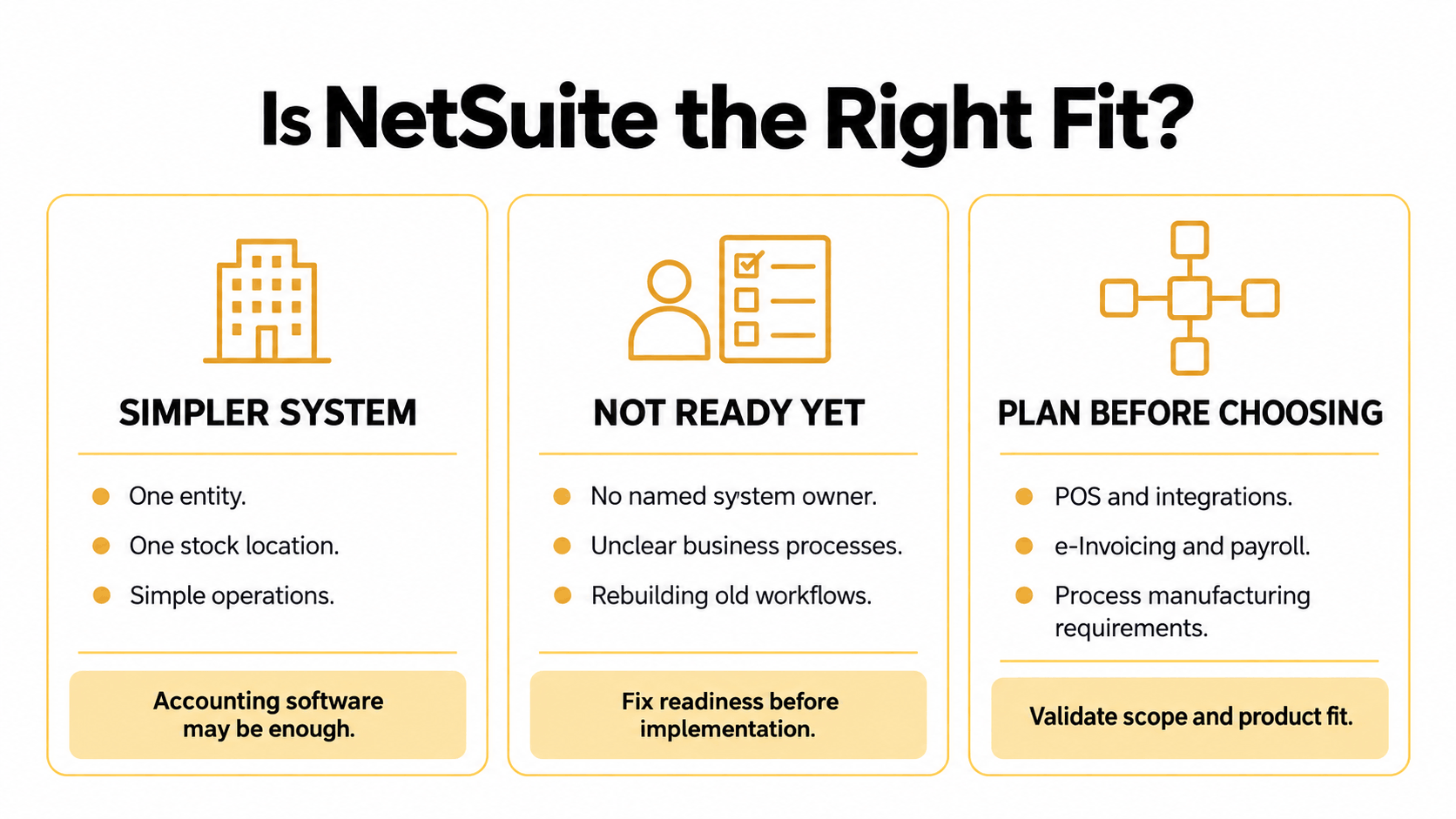
- Wrong fit: your operation is simple enough that accounting software already does the job. Don’t buy NetSuite.
- Wrong timing: NetSuite would suit your operation, but your business isn’t ready to run it. Fix that first, then revisit.
When a Simpler Accounting System May Be Enough
One company, straightforward processes and little manual reconciliation. If your current accounting and inventory tools handle the work reliably, a NetSuite subscription and implementation may add more cost and complexity than value.
Even a single entity can have demanding processes. But multi-location stock, landed cost and basic assemblies are not, on their own, reasons to switch: AutoCount and SQL Account offer relevant functions. Consider NetSuite when the processes must be connected across teams and existing tools no longer do that effectively.
When Your Business Isn't Ready for NetSuite Yet
Wrong timing is different: NetSuite may suit the operation, but the business is not ready to manage the change.
Nobody owns it after go-live. Ask who will own NetSuite processes a year after go-live, and whether their workload allows it.
Without a decision-maker, unresolved process questions can become support tickets or workarounds after go-live. The owner needs authority and time, not necessarily an IT title.
The brief is to rebuild the old system. Copying existing screens and reports into a new ERP can create unnecessary customisations. Those changes may need testing and maintenance when NetSuite releases updates.
The first case is a product-fit and cost decision. The second is a readiness problem: even suitable software needs clear processes and someone accountable for running them.
Not sure which side of these lines your business sits on? Talk to BlackOak before the next demo.
The ownership question needs an answer before configuration starts, which is what our guide to what happens before NetSuite go-live covers.
What Requires Additional Planning Before Choosing NetSuite
Even with the right shape and a ready business, some requirements need checking separately.
Most add scope, through a NetSuite module, a SuiteApp or a connected external system. Process manufacturing can also expose a genuine fit limit. Settle scope and fit before you sign.
Process manufacturing. NetSuite supports assembly-based manufacturing, while recipe, formula and batch processes may call for additional capabilities. Oracle’s Advanced Manufacturing datasheet describes recipe management and lot traceability for batch manufacturers.
Oracle also documents component-yield calculations, so yield requirements alone do not establish a gap. Before deciding, test critical needs such as potency controls, yield methods and co-product costing against the exact modules and integrations proposed. If an essential process remains unsupported, a specialist ERP should also be considered.
Point of sale. NetSuite partners including CQL and Anchor Group have reported plans to retire NetSuite POS and SuiteCommerce InStore. Confirm their current support status and replacement options with Oracle before relying on either product.
Retailers should compare available POS solutions and check how sales, stock and payments will connect to NetSuite. Integration needs may affect both project scope and the overall product decision.
Does NetSuite Handle Malaysian e-Invoice and SST?
Malaysian compliance needs should be scoped separately from core ERP functions:
- SST requires suitable tax configuration
- e-Invoicing needs a working submission route to LHDN’s MyInvois
Two relevant NetSuite e-Invoicing approaches are discussed here; other options exist.
One is Oracle’s Malaysia Electronic Invoicing SuiteApp. For its Avalara-based workflow, Oracle says Avalara must be registered as an intermediary in the MyInvois Portal. Oracle’s Avalara for E-Invoicing documentation specifies two active paid licences and sufficient processing volume for Avalara transactions:
- NetSuite Electronic Business Network Extension
- Electronic Document Processing Cloud Service
The other is BOC e-Invoice, which BlackOak describes as a NetSuite-native integration connecting directly to LHDN’s MyInvois API, without third-party middleware.
Which of the two fits your business better depends on:
- Your transaction volume
- The total cost of each route
- Who will manage the integration after go-live
SST requires someone to maintain tax configuration as rules and transactions change.
Most of these add to the project, and some keep adding cost after go-live. Together with shape and readiness, they make up a check you can run before any demo.
Not Sure NetSuite Fits? Start With a Conversation
Limitations of the Relaxation Period
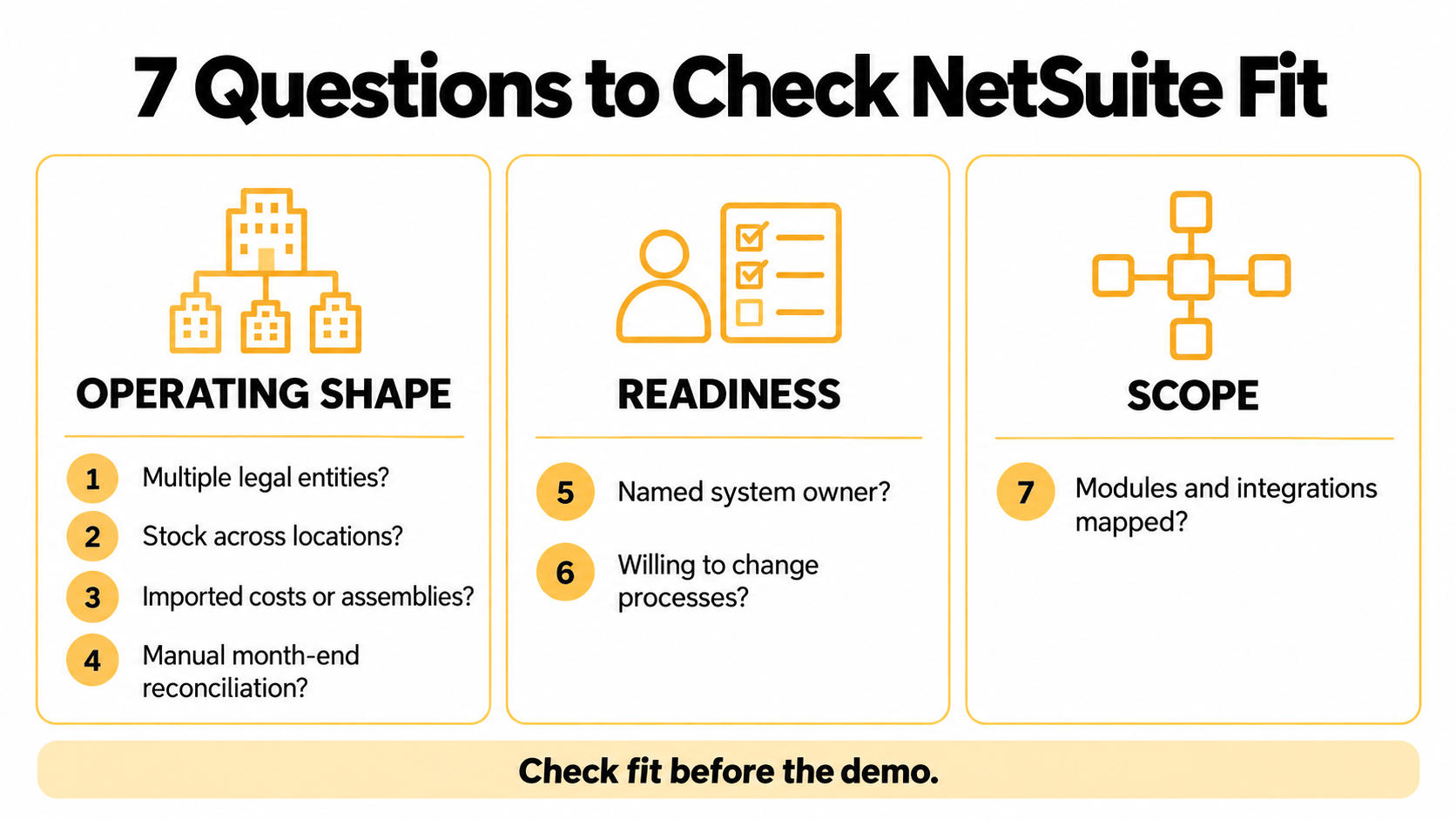
Use these seven discussion questions, grouped by operating shape, readiness and scope. They guide a fit review; they are not a pass-or-fail product test.
Operating shape
1. Do you run, or plan to run within two to three years, more than one legal entity?
2. Is stock held in more than one location or sold through more than one channel?
3. Do imported goods or assemblies affect your costing?
4. Does month-end close depend on spreadsheets that re-key data between systems?
Readiness
5. Can you name the person who will own NetSuite processes after go-live?
6. Are you willing to change processes rather than rebuild the old system?
Scope
7. For POS, e-Invoicing and any process manufacturing, do you know which will run on a NetSuite module or SuiteApp, which on a connected external system, and who will maintain each after go-live?
Few signs of operational complexity may mean accounting software is sufficient. If the processes are complex but nobody owns them, address readiness before implementation. Unclear integrations call for more scoping.
The answers are starting points, not a score. Where NetSuite remains a candidate, test it with a scripted demo using your own transactions. Then assess the full contract cost before deciding.
What Shapes the Cost of NetSuite After Year One?
Budget separately for the recurring NetSuite subscription, a usually one-off implementation project and ongoing support. Your subscription quotation may cover edition, user licences, modules and service tier, as discussed on our Oracle NetSuite Malaysia page. Ask the implementation partner what its proposal includes and what may be billed later.
Check the scope of ongoing support and upkeep:
- Customisations retested at each release
- Configuration changes such as SST updates
- Post go-live support
Transaction volume can also affect the service tier a business needs. Oracle’s service tier structure lists up to 100 users and 200,000 monthly transaction lines for Standard, averaged over six months.
For businesses that grow beyond those limits, Oracle offers higher service tiers: Premium, Enterprise and Ultimate. A marketplace-heavy seller should forecast transaction lines, not just the number of orders.
Review renewal terms and model costs over several years before signing. Agree who will budget for subscriptions, support, integrations and maintenance after go-live.
So, Is NetSuite the Right ERP System for Your Business?
NetSuite deserves consideration when business processes need closer coordination and the team is ready to own them. A simpler system may be sufficient; an unprepared business may need to wait. Specialised requirements must be tested before the decision.
Then compare the expected benefits with the total cost over several years. No model can guarantee the return.
A demo shows what NetSuite can do. A fit check shows what your business will actually use.
Why BlackOak Consulting

The fit questions above help clarify what a business should ask before commissioning an ERP implementation.
- Certified Oracle NetSuite partner serving Malaysian manufacturers and retailers
- 17+ years of ERP consulting experience, 50+ projects delivered and 50+ combined years of team expertise
- Business-process and implementation considerations explained alongside NetSuite capabilities
- Oracle’s e-Invoicing SuiteApp and BOC e-Invoice presented side by side during scoping
Not Sure NetSuite Fits? Start With a Conversation
Frequently Asked Questions
NetSuite is an ERP system. It runs accounting, inventory, orders, purchasing and multi-entity consolidation on one database.
AutoCount and SQL Account also have inventory and related modules. NetSuite may be more suitable when the main challenge is coordinating transactions, reporting and controls across multiple entities and departments.
No. NetSuite is a paid annual subscription covering the core platform, optional modules and users, plus a one-time implementation fee.
Oracle quotes the subscription per business rather than publishing a price list, and the implementation partner quotes the fee.
NetSuite ERP and SAP Business One are both mid-market suites, but they're run differently.
NetSuite is natively a web solution, and every customer is upgraded on the same release cycle, which suits businesses that configure rather than customise heavily.
SAP Business One can run on premises or in hosted environments. Upgrade scheduling depends on the deployment and support arrangement, so compare the actual contract rather than assume a universal advantage.
NetSuite’s main drawbacks are trade-offs of its cloud model and scope. Oracle sets the release calendar, and you choose an upgrade slot within it.
There’s no on-premises option, because NetSuite is delivered only as a cloud subscription.

About the Author
Kuan Boon Lim
Meet Kuan Boon Lim, the Netsuite Proselytizer wanabee! who is dedicated to spreading the good word about seamless business management and NetSuite to all who will listen. With years of experience in ERP pre-sales, implementation, he is fully equipped to help businesses of all sizes take their operations to the next level.
He is currently the GM of Pre-sales for BlackOak Consulting Sdn Bhd.
